Fun Ways to Help Your Child Learn Math at Home
 By
By Fun Ways to Help Your Child Learn Math at Home
Math is part of everyday life, even when we don’t really think about it. Children start using basic math skills long before they enter school. They learn to count, compare amounts, recognize patterns, and gradually understand simple addition and subtraction through ordinary experiences.
For example, a young child may quickly realize that having two cookies and giving one away leaves only one cookie. They may not call it “subtraction” yet, but they are already beginning to understand the idea.
So, how can parents make the most of these everyday learning opportunities?
Once children begin school, they will naturally be introduced to more formal math concepts. Still, parents can help by making simple connections between mathematics and things children already enjoy doing at home. There is no need for long lessons or complicated worksheets. A few minutes of playful practice can be enough.
Baking Can Be a Math Lesson
The kitchen is a surprisingly good place to practice math. Baking and cooking involve measuring, counting, comparing, adding, and sometimes even multiplying or dividing.
For example, if a recipe calls for one cup of flour and you want to make twice as much, your child can help work out how many cups are needed. You can also ask them what happens when you make only half of the recipe.
Younger children can help with easier jobs, such as counting eggs, measuring ingredients, or putting a certain number of spoonfuls into a bowl. These small tasks allow them to practice numbers without feeling like they are doing schoolwork.
Build and Learn with Toys
Building toys such as LEGO bricks, wooden blocks, and construction sets are excellent for developing math skills. Children can count pieces, compare sizes, create groups, and explore simple addition and multiplication while they play.
You can ask questions such as, “How many blocks did you use?” or “Can we build another tower with the same number of blocks?” These simple questions encourage children to think about numbers and quantities.
You can also use everyday items for building. Empty cereal boxes, cardboard containers, and plastic cups can become part of a small construction project. While playing, children naturally begin to notice shapes, sizes, and how different objects fit together.
Try setting aside a few minutes each day for building together. It can be a fun activity for both of you while quietly reinforcing important math skills.
Play with Shapes
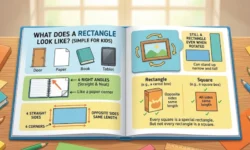
Shape-sorting toys are another simple way to introduce children to geometry. Sit down with your child and explore the different shapes together.
Ask them to name a circle, square, triangle, or rectangle. You can also count the sides and corners of each shape. For example, ask, “How many sides does this triangle have?”
As children become more familiar with shapes, encourage them to look for them around the house. A clock might look like a circle, while a door may remind them of a rectangle.
These little observations help children understand that geometry isn’t something that exists only in a textbook. Shapes are all around them.
Use a Timer During Play
Many children find timers, stopwatches, and hourglasses fascinating. Instead of simply letting them play with these objects, you can turn their curiosity into a simple math activity.
Try setting a timer for 30 seconds and asking your child to count how many jumps, claps, or blocks they can make before the timer ends. You can repeat the activity and compare the results.
You can also let children look at the numbers on a stopwatch or digital timer and practice reading them. These activities help them become familiar with numbers while also introducing the idea of time.
Over time, children begin to understand that some activities take longer than others and that time can be measured.
Give Your Child a Piggy Bank
A simple piggy bank can provide plenty of opportunities to practice math. You don’t need to turn it into a formal lesson. Simply count the coins together and talk about their values.
For example, you might ask, “How many coins do we have?” or “If we add two more coins, how many will there be?”
Older children can think about saving for something they want. You can discuss how much money they have already saved and how much more they need.
This gives children a practical reason to use addition, subtraction, counting, and comparison skills. It also introduces them to the basic idea of saving and making choices about money.
Make Math Part of Everyday Life
Helping children learn math at home doesn’t require special equipment or hours of practice. Everyday activities such as baking, building, playing with shapes, using a timer, or counting coins can become small learning opportunities.
The most important thing is to keep these activities relaxed and enjoyable. When children see that math is connected to things they already do and enjoy, they are more likely to become curious about numbers and confident in using them.