Math in Preschool: What Children Really Need
 By
By Math in Preschool: What Children Really Need
When we hear “math in preschool,” we may immediately think of numbers, counting, simple calculations, or even the first math worksheets. But early math learning is much broader than that. What do young children really need before they enter the world of numbers?
The answer is not endless worksheets or memorizing formulas. Preschool mathematics is about curiosity, play, everyday experiences, and giving children opportunities to explore mathematical ideas in ways that feel natural and enjoyable.
Start Early—But Where Should You Begin?
Long before children can add or subtract, they are already developing important mathematical abilities. They notice quantities when they say, “I have more gummy bears than you!” They compare sizes, recognizing that one ball is bigger than another. They also begin to understand order and sequence, such as knowing who is first or who comes next.
These early abilities are often referred to as prenumerical skills. They provide an important foundation for the mathematical understanding children will develop later.
For this reason, preschool math should not be about teaching school material ahead of time. Instead, it should help children strengthen the mathematical thinking they already use naturally. Comparing, sorting, organizing, observing, and experimenting can all happen through play.
What Do Children Really Need?
Everyday Situations Instead of Abstract Theory
Math is part of everyday life. It appears when setting the table and asking, “How many plates do we need?” It comes up while baking when ingredients need to be measured. During a game, children learn about taking turns and deciding who goes first. Even shopping can become a simple math experience when asking whether there are enough apples for everyone.
These ordinary moments provide excellent opportunities to develop mathematical thinking without making children feel as though they are studying.
Parents and caregivers play an important role. Simply talking about numbers, quantities, sizes, positions, and comparisons encourages children to notice mathematics in the world around them.
Learning Through Play
Play is one of the most natural ways for preschool children to learn. Dice games, building blocks, puzzles, shapes, and simple board games can support mathematical development while children are having fun.
Through these activities, children gradually encounter ideas such as more, less, equal, bigger, smaller, and greater. Building towers with blocks or creating structures with LEGO can also develop spatial and mathematical thinking, even when no numbers are involved.
Language Helps Build Mathematical Understanding
Mathematics also depends heavily on language. Words such as “before,” “after,” “between,” “round,” “square,” “half,” and “whole” may seem simple to adults, but they can be quite abstract for young children.
That is why it helps to use mathematical language naturally throughout the day and connect words with real objects and actions. When children hear and use these terms regularly, they gradually become more comfortable with mathematical ideas.
Strong language development can also support children’s understanding of numbers and relationships as they grow.
Give Children Time and Plenty of Repetition
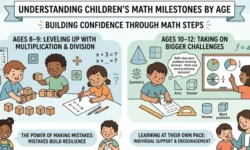
Children do not all understand mathematical concepts at the same speed. Some may grasp a relationship quickly, while others need to experience it several times before it becomes clear.
Repetition is therefore an important part of learning. Children need time to think, make mistakes, try again, and discover their own solutions.
Adults do not need to immediately correct every mistake. Patient guidance is often much more helpful than criticism. Mistakes are a normal and valuable part of learning.
Keep the Joy of Discovery Alive
Math can be fascinating when children are given the freedom to explore it. When a child discovers that there can be several ways to solve a problem, they begin to see themselves as capable thinkers.
Instead of always being told what the “right answer” is, children benefit from being encouraged to make predictions, test ideas, and try different approaches.
This freedom builds confidence—and confidence is one of the strongest foundations for successful learning later in school.
What Preschoolers Don’t Need
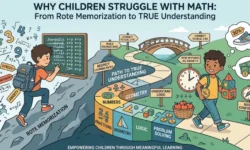
First-grade-style math problems: Giving young children exercises such as “5 + 3 = ?” before they understand the quantities involved can easily turn mathematics into a source of frustration.
Pressure or comparisons: Children develop at different rates. Preschool should not become a competition over who can count higher or solve problems faster.
Lectures and repetitive drills: Preschool math should not feel like a formal school lesson. Mathematical ideas are much easier to understand when they are connected to children’s real experiences, interests, and play.
Practical Ideas for Home and Daycare
Counting Games: Count steps while climbing stairs, beads while making a necklace, or pieces of fruit while sharing a snack.
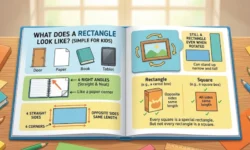
Shape Safari: Look around the house, classroom, or playground for objects that are round, square, rectangular, or pointed.
Compare Quantities: Ask questions such as, “Who has more blocks?” or “How many spoons do we need for three children?”
Sort and Organize: Sort buttons by color, stones by size, or socks into matching pairs. These simple activities encourage logical thinking.
Create Patterns: Alternate red and blue beads, make repeating movements, or create simple clapping patterns. These activities help children recognize and predict patterns.
Math Begins With Curiosity
Math in preschool is not about preparing children for tests, quizzes, or worksheets. It is about encouraging them to notice, wonder, ask questions, and experiment.
It can begin with something as simple as counting stairs, comparing two toys, sorting socks, or looking for shapes in the environment.
Young children do not need piles of worksheets. They need adults who are willing to explore, compare, count, talk, build, and play alongside them.
When children discover early that mathematics can be enjoyable and interesting, they are more likely to approach future learning with confidence, curiosity, and a positive attitude.