Math Exercises for 1st Grade: How Kids Can Practice Without Pressure
 By
By Math Exercises for 1st Grade: How Kids Can Practice Without Pressure
Starting first grade is an exciting time, but it also brings a lot of new experiences for children and their parents. Math is one of them. Some children enjoy numbers from the beginning, while others need a little more time to feel comfortable.
Parents often wonder how much math practice is enough. Should their child already be able to calculate quickly? How long should homework take? And what should they do when a simple exercise seems to become a big struggle?
The good news is that first-grade math does not need to be stressful. At this age, children learn best through short activities, simple examples, and everyday situations. A few minutes of relaxed practice can often be much more useful than sitting at the table for a long time.
Math Exercises for 1st Grade: Start Slowly and Build Confidence
The main purpose of first-grade math exercises is not to make children fast calculators. It is to help them understand numbers and become comfortable working with them.
During the first year of school, children usually learn to recognize quantities, count forward and backward, write numbers, compare amounts, solve simple addition and subtraction problems, and understand basic mathematical symbols.
Understanding should come before speed.
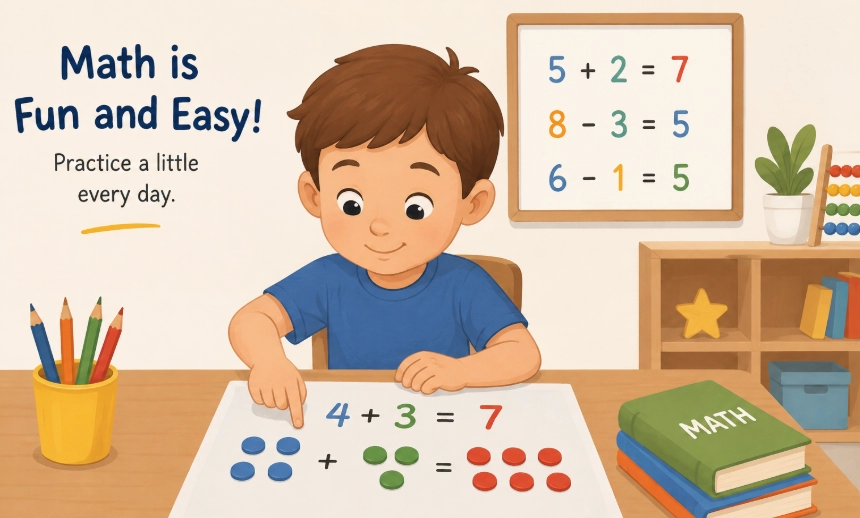
For example, if a child needs a little extra time to solve 5 + 3, there is no need to rush them. They might count on their fingers, use small objects, or draw a picture. These are all perfectly reasonable ways to solve a problem at this stage.
At home, try keeping practice sessions short. Ten minutes of calm practice can be enough. If your child is tired after school, it may be better to take a break and try again later.
Instead of saying, “That’s wrong,” you can ask, “How did you get that answer?” This gives the child a chance to explain their thinking and helps you understand where they may be having difficulty.
What Do First-Graders Really Need to Know in Math?
Math in first grade starts with very basic ideas. Before children can work comfortably with written equations, they need to understand what numbers actually represent.
They learn by looking at objects, moving things around, grouping them, counting them, and talking about what they see.
Important Foundations
Understanding quantities:
Children should gradually learn to recognize small groups of objects and understand that a number represents a specific quantity.
Following number sequences:
Counting forward and backward is an important early skill. Children can also practice continuing a sequence from a number other than one.
Understanding math symbols:
The plus, minus, and equals signs have meanings. Children need time to understand what these symbols are telling them rather than simply memorizing them.
Breaking numbers apart:
Numbers can be made in different ways. For example, seven can be divided into five and two, four and three, or six and one.
Talking about mathematical thinking:
Children benefit from explaining what they are doing. Questions such as “What did you add?” or “How many did you take away?” encourage them to put their thinking into words.
These skills are more valuable than completing a large number of worksheets. A child who can explain a problem, draw it, or demonstrate it with objects is developing a strong mathematical foundation.
First-Grade Math Problems: Easy Ideas to Try at Home
Math practice at home does not always have to look like schoolwork. In fact, simple activities using things around the house can make numbers easier to understand.
Many first-graders begin with numbers up to ten and gradually move toward numbers up to twenty. However, children develop at different speeds, so it is a good idea to follow what they are currently learning at school.
Addition with Everyday Objects
You can turn ordinary objects into simple math problems.
Put four pieces of pasta on the table and add three more. Ask, “How many are there altogether?”
Place five apples in a bowl and add two. “How many apples do we have now?”
Give your child six building blocks and then add one more. “How many blocks are there now?”
Put three pencils on the table and ask your child to add four more.
The objects make the calculation visible, which can be much easier for a young child to understand.
Subtraction in Everyday Situations
Subtraction can also be introduced naturally during daily activities.
There are eight grapes on a plate. If three are eaten, how many are left?
A tower has ten blocks. Two blocks fall down. How many remain?
Put seven pencils in a box and take one out. How many are still inside?
Give your child six toy cars and put two away. Ask how many are left.
Children often understand subtraction more easily when they can physically remove objects and see what happens.
Comparison Activities
Comparison is another useful part of early math.
You might ask:
Who has more blocks?
Which group has fewer objects?
How many more are needed to make the two groups equal?
Which number is smaller?
Which group has the same number of objects?
These questions encourage children to think about quantities rather than simply calculate an answer.
Most importantly, give your child time to work things out. If they want to use their fingers, let them. Fingers are a natural and useful counting tool for young children. There is no need to discourage this habit before they are ready to move on.
First-Grade Homework: How Parents Can Keep Things Calm
Homework can be one of the biggest changes when a child starts first grade. After spending several hours at school, some children come home ready to begin their homework immediately. Others are tired, hungry, or simply need some time to play and relax.
There is no single routine that works for every family. What matters most is having a simple routine that your child can understand and expect.
A Simple Homework Routine
Give your child some time after school:
Let them have something to eat or drink, talk about their day, or simply relax for a while.
Prepare the workspace:
A notebook, pencil, eraser, and any other necessary materials are usually enough. A quiet and comfortable place can help children focus.
Look at the assignment together:
If the instructions are confusing, read them with your child and make sure they understand what they are being asked to do.
Let your child take the lead:
Try not to correct every small mistake immediately. Give them an opportunity to think and solve the problem independently.
Notice the effort:
A simple comment such as “You worked hard on that one” can encourage a child without putting pressure on getting every answer right.
When a math question seems difficult, parents can guide without giving away the answer. Instead of solving it for the child, try asking questions such as:
“Can you show me the problem with pencils?”
“What do you already know?”
“Can you draw what is happening?”
“What happens if we count the objects?”
These small prompts can help children discover the answer themselves.
Keep Math Practice Positive
The first year of school is about building confidence as much as learning new skills. Children do not need to master everything immediately.
Short activities, everyday examples, and patient encouragement can make math feel much more manageable. When children are given enough time to think and are allowed to make mistakes, they gradually become more confident.
The goal of first-grade math practice is not to finish as many questions as possible. It is to help children understand numbers, enjoy discovering solutions, and develop the confidence to say, “Let me try.”