Nurturing a Love of Learning Math
 By
By Nurturing a Love of Learning Math
Math practice at home does not have to turn into a daily struggle. With a little patience, a simple routine, and the right kind of encouragement, parents can help children feel more comfortable with numbers. Small moments of success can make a big difference, especially when children begin to believe, “I can do this.”
Math Problems for 3rd Grade: Building Confidence Without Pressure
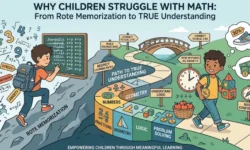
Many parents know the scene all too well. It is time to practice math, the workbook comes out, and suddenly the child loses interest. What started as a simple exercise can quickly become frustration, arguments, or tears.
During elementary school, from first through fourth grade, learning math is about much more than getting the right answer. Children also need motivation, a routine they can manage, and the confidence to keep trying when something seems difficult.
Whether children are working on arithmetic problems in first grade, practicing math exercises, solving math problems for third grade, exploring a geometric shape, or learning about numerators and denominators, they usually learn best when the tasks fit naturally into everyday life.
Parents do not need to become strict teachers at home. In fact, too much pressure can make children associate math with stress. A better approach is to offer encouragement, keep practice sessions short, and help children discover how useful math can be in everyday situations.
For example, instead of simply explaining fractions, parents can use food to make the idea easier to understand. Cut an apple into three equal pieces and ask, “If we have three equal pieces, what is one third?” Suddenly, the question becomes something the child can see and understand.
Motivation usually does not come from long explanations or repeated reminders to work harder. It develops gradually through small achievements, positive attention, suitable activities, and enough time to rest. These simple elements can create a much healthier learning routine.
Why Motivation Looks Different in Elementary School
Young children learn in many different ways. They learn by talking, moving, touching, observing, and trying things for themselves. This is especially important when they are learning mathematical ideas that may seem abstract at first.
Take fractions, for example. A child may have difficulty understanding a definition in a workbook, but the concept can become much clearer when an apple, sandwich, or piece of paper is divided into equal parts.
The same applies to numerators and denominators. Rather than asking children to memorize two unfamiliar words, parents can show them what the fraction actually represents. The denominator tells us how many equal parts the whole has been divided into, while the numerator tells us how many of those parts we are talking about.
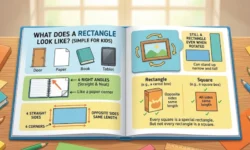
Geometry can also be found almost everywhere around us. A table may have a rectangular surface, a plate may look like a circle, and a traffic sign may have a triangular shape. Once children start noticing these examples, mathematics becomes part of the world they already know instead of something that exists only in a textbook.
Third-grade math problems can be particularly challenging because several skills are often needed at the same time. Children may have to calculate carefully, understand a word problem, recognize geometric shapes, work with fractions, and explain how they reached an answer.
It is completely normal for a child to feel unsure when several new skills come together.
Parents can help by giving children time to think instead of immediately showing them the solution.
Try asking:
“What do you understand so far?”
“What could we try first?”
“Can you explain how you got that answer?”
“Is there another way to solve it?”
These questions encourage children to think about their own strategies instead of simply waiting for an adult to provide the answer.
It is also helpful to notice progress, even when the final answer is incorrect. Saying, “You found a good way to start,” can be much more encouraging than focusing only on the mistake.
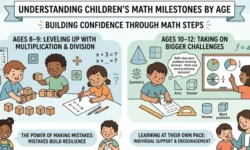
Mistakes are part of learning, too. Rather than treating them as failures, parents can use them as an opportunity to look more closely at the difficult part.
Short practice pages can also be useful when a child needs extra review. For example, a few exercises about identifying numerators and denominators can reinforce what was already introduced at school. These activities are most effective when they are brief and followed by encouragement rather than pressure.
Creating a Math Routine That Fits Family Life
A useful study routine does not need to be complicated or strict. What matters most is that children know roughly what to expect.
When children know when practice will happen, how long it will last, and what they can do afterward, starting the task often becomes easier.
After a full school day, however, children may need some time first. They might want a snack, a drink, a little conversation, or simply a chance to play and move around.
A simple routine could look something like this:
Come home, have a snack, take a short break, practice math for ten or fifteen minutes, look at the work together, and then move on to play or another activity.
There is no single perfect time for every child. Some children concentrate better in the afternoon, while others may prefer a short session on weekend mornings. The important thing is to find a time that works for the family and keep it reasonably consistent.
For first graders, even a few minutes can be enough. Children can practice counting, compare quantities, solve simple addition and subtraction problems, or use blocks and toys to represent numbers. Math exercises in first grade can be playful rather than formal.
By third and fourth grade, children may be ready for slightly longer and more organized practice. Even then, the goal should not be to keep them working for as long as possible. Short, focused practice is often more useful than a long session filled with frustration.
A Gentle Math Routine Could Include
Starting signal: Gather the books, pencils, and other materials together.
Small goal: Decide on one simple thing to practice that day.
Practice time: Work for a short, focused period rather than continuing endlessly.
Quick review: Look at what went well and talk about anything that was difficult.
Next step: Let the child know what they will work on another day.
If a child regularly refuses to practice, it does not automatically mean they are lazy or uninterested in learning. Sometimes the exercises are simply too difficult. In other cases, the instructions may not be clear, or the child may already connect math practice with previous stressful experiences.
When that happens, the best first step is often to make starting easier. Choose one manageable problem, sit nearby, and give the child enough time to think.
The goal is not to make every math session perfect. The goal is to help children gradually develop confidence, curiosity, and the feeling that difficult problems can be worked through one step at a time.