The Best Way to Teach Math at Home
 By
By The Best Way to Teach Math at Home
Let’s be real: for a lot of students, the biggest hurdle in math isn’t their natural ability—it’s fear. Math anxiety is a very real thing that directly messes with a student’s problem-solving skills, especially when they hit the tough questions. But kids who realize they can actually improve through effort tend to stay motivated much longer than those who give up at the first sign of struggle.
The good news? You don’t need a pricey tutor on speed dial or hours staring blankly at a textbook. You just need a better approach: short, regular sessions focused on truly understanding the concepts, rather than blindly memorizing them.
Focus on the “Why,” Not the Memorization
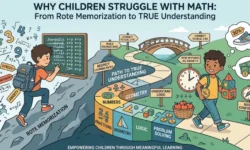
Most of us were taught math the wrong way. We drilled our times tables, frantically copied whatever the teacher wrote on the board, and crossed our fingers on test day. That works temporarily, but eventually, it hits a wall.
Instead of memorizing a script, students need to build a toolkit. Good mathematicians don’t just rely on their memory; they actually understand how numbers play together. Look at the difference:
Memorization: 8 × 7 = 56.
Number sense: 8 × 7 is just (8 × 5) + (8 × 2). That’s 40 + 16, which is 56.
Sure, the second way takes a few seconds longer at first. But this exact way of thinking is what saves you later in high school algebra and calculus. Grasping the “why” behind the numbers beats robotic drilling every single time.
Make It Visual
Math isn’t just a bunch of abstract numbers floating in space; it’s a highly visual subject. If a concept isn’t clicking, draw it out. Instead of just writing out fractions, use clear visual models like fraction bars to show how pieces make up a whole. When tackling algebra, explain it using the concept of a physical balance scale—whatever you add or remove from one side, you must do to the other to keep it level. Today’s digital landscape offers incredible interactive drag-and-drop web activities. Letting kids visually manipulate geometric angles or balance equations on a screen helps them actually see the math unfold.
Take It Step-by-Step
Long equations look terrifying on paper. But if you slice them into bite-sized pieces, they completely lose their bite. This is exactly how professionals work. Look at this example:
Solve: $3(2x + 5) = 21$
Step 1: Unpack the parentheses → $6x + 15 = 21$.
Step 2: Subtract 15 from both sides → $6x = 6$.
Step 3: Divide by 6 → $x = 1$.
Every step is incredibly simple on its own. Together, they solve the whole thing. It turns a massive, intimidating wall into a manageable staircase.
Mix Up Your Practice
Doing the exact same type of problem forty times is mind-numbing. If you want to study effectively in 2026, mix it up. Tackling different kinds of questions in one sitting forces your brain to stay awake and think flexibly. Try a quick, varied routine like this:
Five algebra problems
Three geometry questions
Two mental math brain-teasers
That’s just 15 to 20 minutes of work. It builds real problem-solving chops without the burnout. Students who mix up their practice consistently outperform those who just hammer away at one single topic.
The Power of Immediate Feedback
When a student finally nails a hard question, they shouldn’t have to wait for a teacher to grade it days later to feel good about it. Immediate feedback builds incredible momentum. Incorporating gamified elements into learning makes a massive difference here. Whether it’s an interactive online quiz that plays a satisfying victory melody, or a fun little burst of virtual confetti on the screen for a correct answer, those small rewards matter. It transforms a stressful chore into an engaging challenge.
Keep It Real
Abstract math feels pointless. Tie it to everyday life, and it sticks because your brain actually cares about the context. Math is hiding everywhere:
Budgeting and calculating taxes.
Scaling up a recipe without ruining the food.
Debating sports stats and probabilities.
Calculating distance and gas for a road trip.
When math matters to your day, you stop hearing that classic complaint: “When will I ever actually use this?” You’re already using it. Real-world learning doesn’t just make math easier—it makes it worth doing.