Practicing 1st-Grade Math at Home Without the Stress
 By
By Practicing 1st-Grade Math at Home Without the Stress
Practicing math at home doesn’t have to become a daily struggle. With short routines, playful activities, and a little encouragement, children in first grade can practice important skills while gradually becoming more confident.
Math Problems for 1st Grade: Helping Children Learn Without Pressure
When children begin solving math problems in first grade, getting the correct answer is only part of the process. They are also learning to trust themselves: I can count. I can compare things. I can recognize a shape. I can try to solve a problem. These small experiences can make a big difference in how children feel about learning.
Many parents search online for phrases such as “preschool math,” “first-grade math,” “first-grade math practice,” and “first-grade geometry.” Although the searches are different, the concern behind them is often similar: How can I help my child learn without making home feel like another classroom?
Fortunately, children usually don’t need hours of extra practice. A few minutes on a regular basis can be much more useful. What matters most is having activities that fit their age, keeping expectations realistic, and staying patient when an answer doesn’t come easily. There are many simple ways to make math part of everyday life.
Why Math Motivation Can Be Tricky in First Grade
Starting first grade is a big change for children. They have to get used to a new routine, listen carefully in class, complete assignments, and manage many things that were unfamiliar before. Math can sometimes make this adjustment more noticeable because answers often appear to be either right or wrong.
For some children, getting an answer right feels exciting. For others, making a mistake can quickly become frustrating. This is why the way adults react to mistakes matters. When children understand that mistakes are a normal part of learning, they are more likely to keep trying. When they feel that every mistake will be criticized, they may begin avoiding difficult tasks.
Parents can support this process without becoming their child’s teacher. In many cases, motivation grows from three simple experiences:
I understand what I need to do. The task feels clear and manageable.
I can do some of it myself. The child gets the feeling that their own effort makes a difference.
Someone notices that I am trying. Encouragement focuses on the learning process, not only on the final answer.
This is also useful before school starts. Preschool children can explore early math through simple games and everyday experiences. They can count toys, notice patterns on dice, compare objects, or search for shapes around the house. Worksheets can certainly be useful sometimes, but they don’t have to become the center of every math activity.
Seven Simple Ways to Make First-Grade Math More Enjoyable
1. Begin with Something Familiar
Start with a question or activity your child already knows how to handle. A quick success can make a child feel comfortable and ready to continue. Once they are engaged, you can gradually introduce a slightly more challenging problem.
The goal isn’t to make every task easy. It’s to give your child a confident starting point.
2. Bring Math Into Everyday Life
Math practice doesn’t always require a workbook and a pencil. There are opportunities everywhere.
While setting the table, ask your child how many plates are needed or how many are still missing. At the supermarket, they can count fruit, compare quantities, or notice which item has more. Walking outside can turn into a small math game too: look at house numbers, count steps, or find different shapes.
These activities are short, but they help children see that math is useful beyond school.
3. Ask About the Thinking Behind the Answer
Instead of asking only, “What is the answer?”, try asking, “How did you work that out?”
Your child may have counted on their fingers, used blocks, drawn a picture, or solved the problem mentally. Talking about these different approaches helps children discover that there isn’t always just one way to think about a problem.
This can be especially helpful when practicing addition and subtraction within 20.
4. Treat Mistakes as Part of Learning
A wrong answer doesn’t mean that a child is bad at math. It simply gives you information about what they need to practice next.
Rather than saying, “That’s wrong,” try something like, “Let’s look at it together and see where it changed.” This keeps the conversation calm and gives your child another opportunity to think.
A mistake can become a useful learning moment instead of a reason to give up.
5. Add Movement to Math Practice
Some children find it easier to concentrate when they can move around. Math doesn’t always have to happen while sitting at a table.
You can count while walking, jump from one number to another, build groups with blocks, or use objects around the house to demonstrate addition and subtraction.
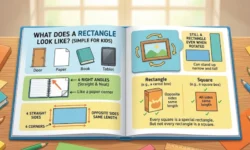
Geometry can be especially fun this way. Look for a circle on a plate, a rectangle in a window, or a triangle in a roof. Once children start looking, they often notice shapes everywhere.
6. Let Your Child Make Small Choices
Giving children a little control can make practice feel less like an obligation.
For example, ask whether they would rather start with a dice game or a shape activity. Maybe they want to use blocks before opening the workbook. The learning goal stays the same, but the child gets to decide how to begin.
Small choices can make a surprisingly big difference in cooperation and motivation.
7. Finish with Encouragement
Try not to let the most difficult question be the final memory of the session. Before stopping, mention something that went well.
You might say, “You kept trying even when that problem was tricky,” or “I liked the way you used your fingers to work that one out.”
Comments like these show children that effort matters. Over time, they can help develop a healthier attitude toward math—one where difficult problems are seen as something to work through rather than something to fear.