Math Teaching Guide for 8-12 Year Olds

Teaching mathematics to children aged 8-12 (approximately from 3rd to 7th grade) is a transitional period where both abstract thinking begins to develop and concrete learning is already critical. Here is a concise guide to effective math teaching for these age groups:
🧠 Characteristics of This Age Group
Characteristic Reflection on Math Teaching
Transition from concrete to abstract. Objects, intermittent, timed use.
Curiosity about play and discovery. Problem-based, gamified activities.
Social Learning. Group work, discussion environment.
Moderate attention span. Activity blocks of 15-20 people.
📚 Basic Topics to be Taught
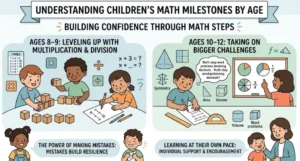
8-9 Years (3rd-4th Grade)
Four Operations: Concretization of multiplication and division concepts.
Fractions: Concept of numerator and denominator, whole-part relationship.
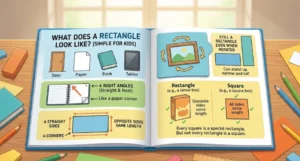
Geometry: Basic words, introduction to area and perimeter.
Measurement: Length, weight, liquid measurements.
10-12 Years (5th-7th Grade)
Decimal fractions and percentages: Connections to daily life (discount, VAT, tip).
Negative numbers: Number situations, temperature, sea level examples.
Ratio-proportion: Recipes, map maker, speed
Algebraic thinking: Variable properties (replace x with “box” or “hidden number”)
Geometry: Angles, polygons, volume
🎯Effective Teaching Methods
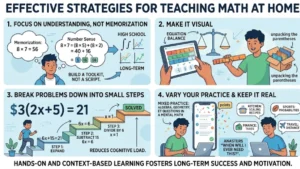
1. Concrete Materials (Manipulatives)
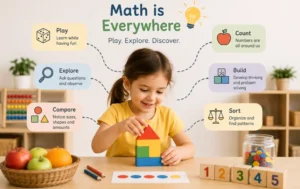
Use physical tools such as fraction rods, base-ten blocks, numbers available, geometrically presented. For example:
Showing multiplication as “3 groups, 4 blocks of each group”
2. Connections to Everyday Life
Shopping and money calculations
Measurement calculations in recipes
Sports scores and statistics
Game scores and level systems
3. Problem-Solving Focused Approach
Instead of giving a formula directly, allow the student to find their own extension:
Ask open-ended questions such as, “If 3 people share a pizza for 5 equally, how much does each person get?”
4. Eliminate the Fear of Making Mistakes
Frame wrong answers as “learning opportunities”
“Why did you think that?” Deepen reasoning with questions
5. Technology and Games
Khan Academy, Prodigy Math, Math Olympiad applications
Geometry and coordinate systems with visual programming like Scratch
⚠️ Common Mistakes and Solutions
Common Mistake Why Solution
Multiplication = Table without understanding Grouping and repeating addition with button setup
Fraction confusion Understanding the numerator-denominator relationship Concrete examples like pizza and chocolate
“Math is difficult” perception Anis s Celebrating small successes, going from simple to difficult
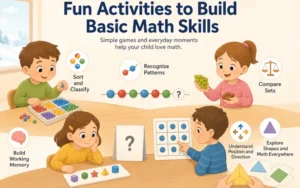
💡 Practical Activity Suggestions
Topic Activity
Fractions Cooking with half and quarter measurements in the kitchen
Ratio-proportion Scaling your own lemonade recipe
Geometry Shown according to accessories at home
Normality Dice rolling experiments and drawing graphs
Percentage Programming store discount tags
📌 Summary: Keys to Successful Math Teaching
Progress step by step from concrete to abstract
Why? Explain every part
Constantly connect with daily life
Be patient; He learns different things about his child
strengthen climate; strengthening success
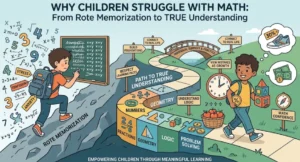
If you present mathematics not as “a subject to memorization” but as “a tool for understanding the world” during this period, both the children’s skills and their attitude towards mathematics will be much more positive in the long run.


Post Comment