Easily Explore Geometric Shapes with Children
Easily Explore Geometric Shapes with Children
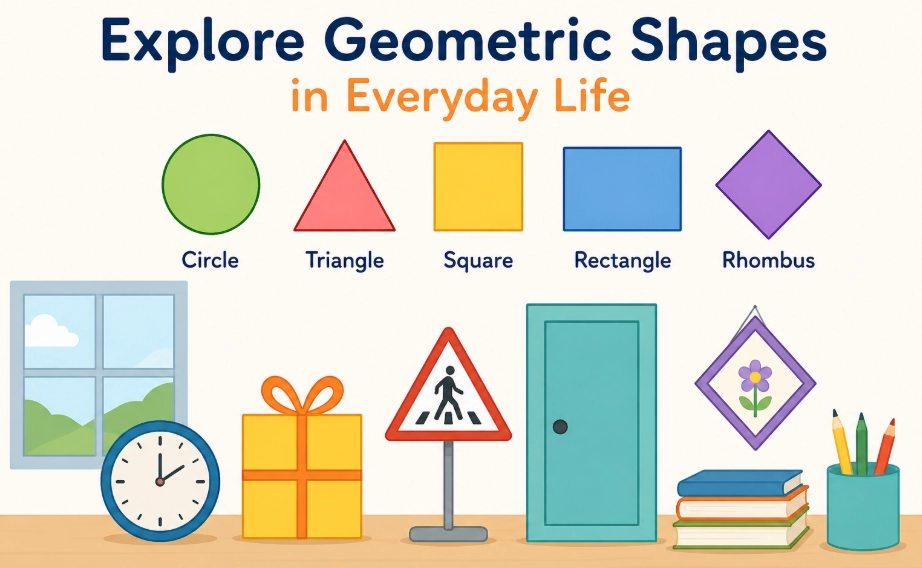
A plate is round, a window is usually rectangular, and a traffic sign may be triangular. Shapes are all around us, often without us even noticing them. For children, discovering these shapes in everyday objects can make learning mathematics much more enjoyable.
This article offers parents and teachers simple ways to introduce geometric shapes in a relaxed and playful manner. Instead of focusing only on memorizing names, children can learn by observing, comparing, touching, and talking about the shapes they see.
Geometric Shapes: Basic Knowledge for Children and Adults
Children come across geometric shapes almost everywhere. A plate may look like a circle, a book may be rectangular, and a building block may look like a cube. When children begin learning geometry, they gradually learn to recognize these shapes, name them, and describe their characteristics.
A geometric figure is a clearly defined shape on a flat surface. Circles, triangles, squares, rectangles, and rhombuses are common examples. Cubes, spheres, and cylinders are different because they are three-dimensional objects. In everyday conversations, both are often simply called “shapes,” which is perfectly fine when children are just beginning to learn.
Plane figures are flat and have length and width.
Geometric solids have height as well and take up space.
Features such as sides, corners, and angles help us recognize different shapes.
The aim is not for children to memorize dozens of shape names as quickly as possible. What matters more is encouraging them to look carefully, make observations, and explain how they reached their conclusions.
Shape Names and Characteristics Explained Simply
Children usually remember a shape more easily when its name is connected to something they can actually see. Instead of simply asking, “What shape is this?”, adults can ask questions such as, “How many sides can you see?” or “Are the sides straight or curved?”
Circle, Triangle, and Oval
Circle: A circle has no corners or straight sides. Its boundary is smoothly curved all the way around.
Triangle: A triangle has three straight sides and three corners. Triangles can look tall, wide, narrow, or tilted, but they still have the same basic characteristics.
Oval: An oval is rounded like a circle but is usually longer in one direction. In mathematics, the more precise term is “ellipse,” although children do not need to learn this term immediately.
Square, Rectangle, Rhombus, and Other Quadrilaterals
Square: A square has four equal sides and four right angles.
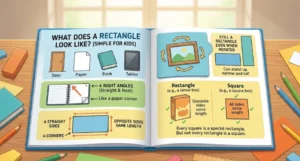
Rectangle: A rectangle has four right angles, while opposite sides have equal lengths.
Rhombus: A rhombus has four sides of equal length, but its angles do not necessarily have to be right angles.
Parallelogram: A parallelogram has two pairs of opposite sides that are parallel and equal in length.
Trapezoid: At elementary level, a trapezoid is commonly described as a quadrilateral with at least one pair of parallel sides.
There is an interesting mathematical connection between these shapes. Every square can also be considered a special rectangle and a special rhombus because it has the required properties of both. However, when children are first learning geometry, it is often easier to introduce the shapes separately. More detailed classifications can come later.
Geometric Shapes in Elementary School
The exact curriculum can vary, but elementary students generally begin by recognizing and naming familiar geometric shapes. As their understanding develops, they learn to describe shapes more carefully and explore symmetry, patterns, two-dimensional figures, and three-dimensional objects.
Children may learn to:
Discover shapes in pictures and everyday objects.
Recognize and name circles, triangles, squares, and rectangles.
Sort objects according to characteristics such as being round, having corners, or having equal sides.
Rotate, flip, separate, and combine shapes.
Explain why a particular shape belongs to a certain group.
These activities help children move beyond simply knowing a name. They begin to understand why a shape has that name and what makes it different from other shapes.
Important Words for Collaborative Learning
Words such as side, corner, angle, opposite, equal in length, parallel, and symmetrical help children describe what they notice.
It is usually better not to introduce too many new mathematical terms at once. A child can first be encouraged to point to something or describe it in their own words. Once they understand the idea, the correct mathematical term can be introduced naturally.
For example, if a child says, “These two sides look the same,” an adult can respond, “Yes, those sides are equal in length.” This approach connects the new vocabulary to something the child has already discovered.
Discovering Shapes Through Play in Everyday Life
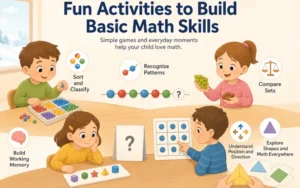
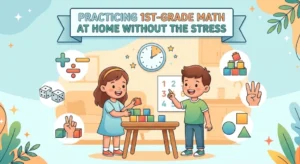
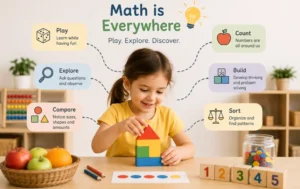
Learning about shapes does not always require worksheets or formal lessons. Everyday activities can provide many opportunities to practice geometry. Children can search for shapes while tidying their room, cooking, playing with blocks, or walking outside.
Here are a few simple activities to try:
Shape hunt: Look around a room and find a circle, two rectangles, and a triangle.
Sorting game: Collect lids, blocks, cards, or tiles and sort them according to their shapes or other characteristics.
Rotation experiment: Turn a square or triangle around and ask whether its name changes when it is rotated.
Shape building: Use sticks, straws, or craft materials to make triangles, squares, and different rectangles.
Touch game: Place a solid shape inside a bag. Let the child feel it and describe its features before looking at it.
These simple games can turn ordinary moments into opportunities for mathematical thinking. Children learn that geometry is not something found only in textbooks—it is part of the world around them.
Most importantly, shape activities should feel like exploration rather than a test. When children are given time to observe, ask questions, make mistakes, and explain their ideas, they can develop a stronger and more natural understanding of geometry.


Post Comment