What Does Mathematics Mean to 11-Year-Old Children?
What Does Mathematics Mean to 11-Year-Old Children?
The age of 11 is an important turning point in a child’s educational journey. Children at this age are no longer learning only through simple examples and repetition. They begin to question ideas more deeply, connect concepts together, and think more independently. Mathematics, in particular, starts to carry a different meaning for them.
For many 11-year-olds, math is no longer just about solving basic operations on a worksheet. It becomes something bigger — a way to think, analyze, compete, and even understand the world around them.
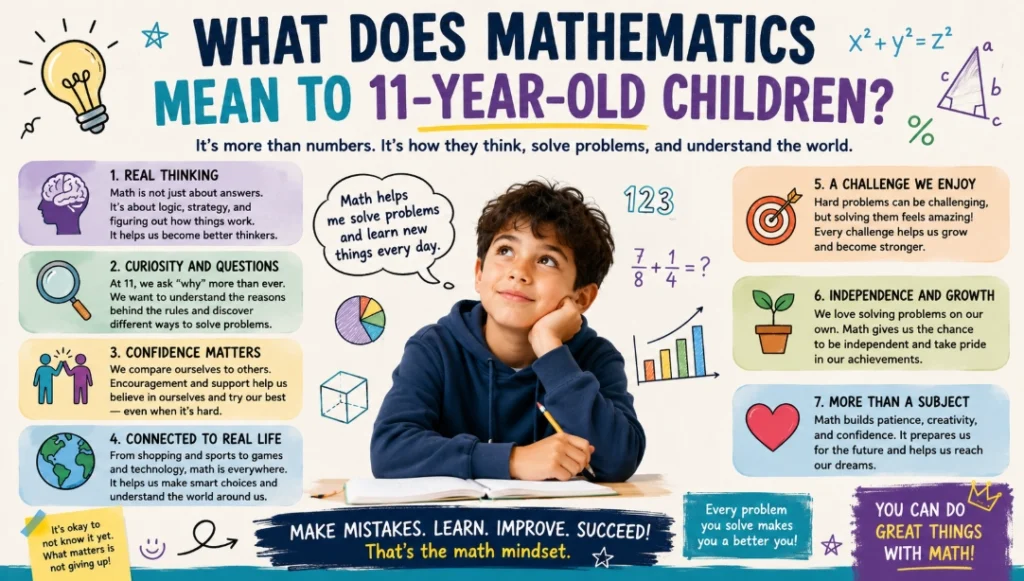
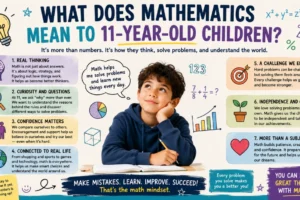
Math Starts to Feel More Like “Real Thinking”
At the age of 11, children begin to notice that mathematics is not only about finding answers quickly. They realize that math requires strategy, logic, and problem-solving skills.
Word problems become longer, fractions and decimals become more detailed, and topics require deeper understanding. Because of this, many children start to see math as a “thinking challenge” rather than a simple school subject.
Some students enjoy this feeling. Solving a difficult problem gives them a sense of achievement and confidence. They feel proud when they discover a solution on their own.
Others, however, may feel frustrated when they cannot immediately understand a concept. At this age, emotions play a big role in learning mathematics. A child who feels supported usually becomes more willing to try again, while a child who fears mistakes may slowly lose confidence.
Curiosity Becomes Stronger
One of the biggest differences in 11-year-old children is their growing curiosity. They ask more questions such as:
“Why does this formula work?”
“Where will I use this in real life?”
“Is there another way to solve this problem?”
They no longer want to memorize every step without understanding it. Instead, they want to explore the logic behind the rules.
This is why math lessons become more meaningful when teachers and parents explain ideas clearly and connect them to everyday life. Children at this age enjoy discovering patterns, relationships, and hidden connections inside numbers.
To them, mathematics can feel like solving a mystery.
Confidence and Comparison Matter More
At 11 years old, children become more aware of their academic abilities compared to others. They notice who solves problems faster, who gets praised in class, and who seems “good at math.”
Because of this, mathematics often affects their self-confidence. A positive experience can make a child feel intelligent and capable. A negative experience, however, may lead them to believe they are simply “not a math person.”
The truth is that most children are capable of learning mathematics when they are given enough time, encouragement, and the chance to make mistakes without fear.
At this age, motivation and emotional support are just as important as teaching formulas and rules.
Math Feels More Connected to Real Life
Unlike younger children, 11-year-olds begin to understand how mathematics exists outside the classroom.
They notice math while managing money, calculating discounts, measuring ingredients, reading statistics in sports, or even playing video games. Technology, coding, and digital games also help many children realize that math is part of the modern world.
When children understand these real-life connections, mathematics feels more useful and interesting. Instead of asking, “Why do I need this?” they begin to see math as a tool that helps people solve problems in everyday life.
Mathematics and Growing Independence
Another important change at this age is independence. Eleven-year-olds want to solve problems by themselves. They enjoy the feeling of discovering answers without constant help from adults.
This is one reason why mathematics can become deeply satisfying for them. Every solved problem feels like proof that they are growing, learning, and becoming more capable.
In many ways, math becomes more than a school subject. It becomes a way for children to test their thinking, patience, and creativity.
Conclusion
For 11-year-old children, mathematics is much more than numbers and operations. It is a subject that challenges their minds, builds confidence, and encourages curiosity.
Their relationship with math during this period often depends on the experiences they have. When children feel supported, encouraged, and free to ask questions, they are more likely to enjoy learning mathematics.
At this age, the goal should not only be teaching correct answers, but also helping children enjoy the process of thinking. Because children who learn to think deeply through mathematics often carry those skills with them for the rest of their lives.