Why Some Kids Love Math and Others Fear It.
Why Do Some Kids Love Math While Others Are Terrified of It?
We’ve all seen the two sides of the coin: one kid’s eyes light up when faced with a problem, tackling it like a thrilling puzzle, while another slumps their shoulders, breaks into a sweat, and gets anxious just hearing the word “math.”
So, what causes this huge gap? Why do some children fall in love with math while others run for the hills? The answer doesn’t lie in their genetic code, as we often assume, but rather in how they were first introduced to this universal language.
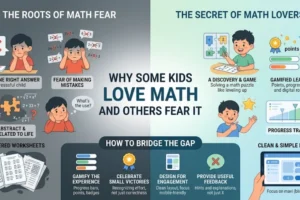
The Roots of Fear: The Pressure of “Only One Right Answer”
Math phobia usually creeps in towards the end of elementary school and peaks during the middle school years (especially between 5th and 8th grades). The sudden influx of abstract concepts and the looming stress of exams turn math from a realm of discovery into a brutal “elimination tool.”
Here is why kids usually develop a fear of math:
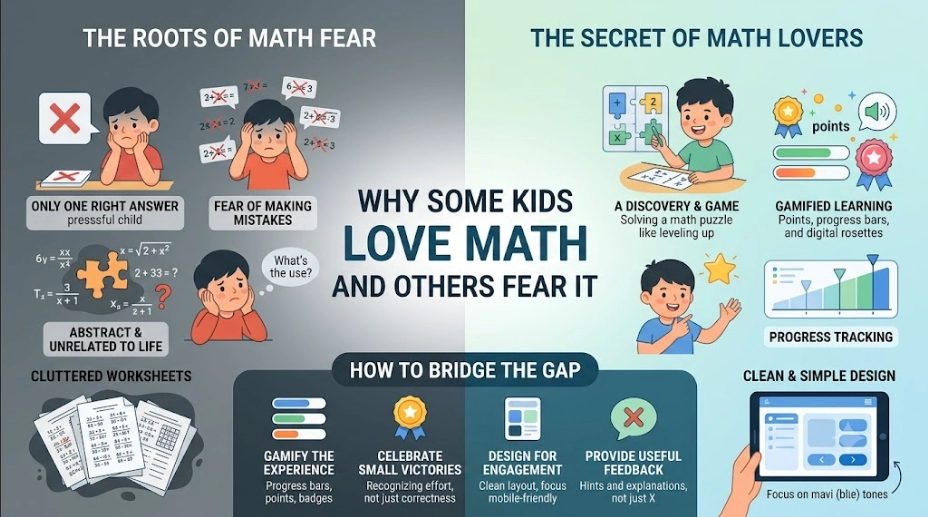
The Fear of Making Mistakes: Dry calculations on paper and the constant pressure of multiple-choice tests leave zero room for error. A single wrong bubble doesn’t just mean a missed question; it triggers a deep-seated feeling of general “failure” in the child.
Abstraction and Lack of Context: When topics are presented as disconnected formulas with no tie to the real world, they just don’t click in a kid’s brain. When the classic question “When am I ever going to use this?” goes unanswered, motivation naturally tanks.
Cluttered and Overwhelming Presentations: Pages crammed with chaotic, messy piles of questions send an immediate distress signal to the brain—“this is too hard”—before the child even finishes reading the first sentence.
The Secret of Math Lovers: A Playground of Discovery
Kids who love math don’t see it as a chore or just another school subject; they see it as a “game” or a secret code begging to be cracked. Solving a problem feels just like leveling up in a video game. And the biggest driving force behind this love? Gamification.
If a math problem is served up on an interactive platform rather than a cold, lifeless test paper, everything changes. Hearing a cheerful success chime when they get the right answer, seeing a progress bar fill up, or watching virtual confetti pop turns a daunting problem-solving process into a fun adventure. While doing math, the child is actually stimulating their brain’s reward center.
How Can We Turn Fear into Love?
Math anxiety isn’t an unbeatable monster. With the right approaches, we can absolutely transform this fear into curiosity and enthusiasm:
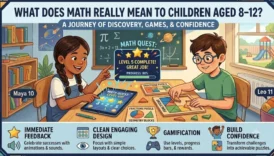
Gamify the Experience: Math shouldn’t be measured purely by four-option multiple-choice questions. Use interactive tools like badge systems, leaderboards, and point-earning dynamics so kids can have fun tracking their own progress.
Celebrate the Small Wins: Don’t just reward the final correct answer; praise the effort it took to get there. Feeling that they are making progress step-by-step builds incredible self-confidence.
Keep Designs Clean and Simple: It’s crucial that learning materials don’t strain the eyes. Instead of a chaotic explosion of colors or alarming shades like bright red, use professional, calming blue tones that boost focus. Presenting spacious, easy-to-read content—even on mobile screens—significantly lightens the cognitive load.
Provide Meaningful Feedback: Instead of just slashing a big red “X” over a wrong answer, offer interactive hints that gently guide them toward the right path.