What Does Math Really Mean to Children Aged 8–12?
 By
By What Does Mathematics Mean to Children Aged 8–12?
For adults, mathematics is often a practical tool used in everyday life. It helps us calculate discounts while shopping, manage monthly budgets, or keep track of bills. For children between the ages of 8 and 12, however, mathematics means something much more significant.
At this age, numbers are not just symbols on a page. Mathematics opens the door to a new world waiting to be explored. Children are no longer simply counting objects they can see; they are beginning to think, reason, and understand ideas that cannot be touched or observed directly. This stage represents one of the most important transitions in cognitive development—from concrete thinking to abstract thinking.
An Adventure or an Obstacle?
In the early years, mathematics is usually enjoyable. Children count apples, sort toys into groups, and solve simple addition and subtraction problems. As they grow older, however, fractions, decimals, ratios, and unknown variables begin to appear. The language of mathematics becomes more complex.
For some children, this new phase is exciting. Every concept feels like a puzzle waiting to be solved. For others, the experience can be challenging. When ideas are not explained clearly or learning becomes repetitive and dull, mathematics may start to feel like a wall that is difficult to climb.
At this age, children often connect their academic performance with their sense of ability. Struggling with a few math problems can sometimes lead them to think, “I’m not good at math,” or even worse, “I’m not smart enough.” That is why mathematics education is about much more than teaching numbers and formulas—it is also about building confidence.
The Power of Achievement
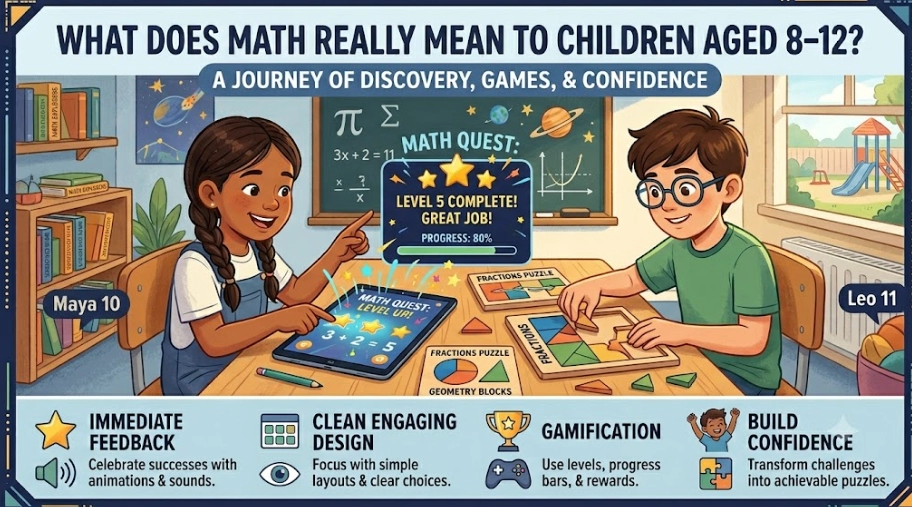
Children learn best when they enjoy the process. Games, challenges, rewards, and small successes play a major role in keeping them motivated. When mathematics is presented only as a collection of rules to memorize, it is natural for children to lose interest.
Everything changes when they experience success. Solving a difficult problem, receiving positive feedback, or seeing their progress can completely transform their attitude toward learning.
For many children, mathematics becomes far more engaging when it feels like an adventure. Each problem is a new challenge, and each correct answer feels like moving up to the next level. This is why interactive activities, educational games, and visual learning tools can make such a powerful difference.
Building the Foundations for the Future
By the ages of 11 and 12, mathematics becomes increasingly abstract. Topics such as factors, multiples, relatively prime numbers, ratios, and early algebraic thinking become part of the curriculum.
During this period, it is important not only to teach rules but also to explain the reasoning behind them. When children understand why a mathematical concept works, they are far more likely to remember and apply it. Information that is learned through memorization alone is often forgotten quickly.
Learning mathematics at this stage is much like constructing a building. The stronger the foundation, the easier it becomes to handle more advanced concepts in the years ahead.
Mathematics Is a Language
For children between the ages of 8 and 12, mathematics is much more than a school subject. It is a universal language that teaches them how to think, make connections, solve problems, and explore different approaches.
As children work with numbers, they are also developing patience, logical reasoning, and resilience. Every problem they solve adds another building block to the way they understand the world.
If parents, teachers, and educators can present mathematics as something to explore rather than something to fear, children will begin to see it differently. Mathematics will no longer feel like a burden they must carry. Instead, it will become a powerful tool, a source of confidence, and a lifelong companion that helps them navigate the world around them.