Quadrilaterals 5th grade Quiz
- Quadrilaterals 5th grade Quiz
- The One Golden Rule
- The "Family Tree"
- Great Job!
Understanding Quadrilaterals: A Quick Guide
Hey there! If you’re diving into geometry, quadrilaterals are one of those core concepts you’ll bump into everywhere. Let’s break it down into plain English.
Basically, a quadrilateral is just any 2D shape with exactly four straight sides. That’s it! The word itself gives it away: “quad” means four, and “lateral” means sides. Think of everyday objects like a door, a computer screen, a kite, or even a classic diamond playing card—they’re all quadrilaterals.
The One Golden Rule
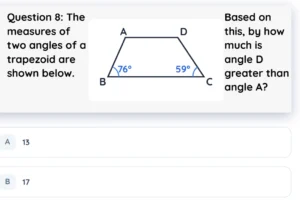
No matter how weird or wonky a quadrilateral looks, there is one rule that never changes: If you add up all four inside angles, they will always equal exactly 360° .
Why? Because if you draw a diagonal line from one corner to the opposite one, you split the shape into two triangles. We know a triangle’s angles add up to 180° circ, so two triangles mean 180° + 180° = 360°. Simple as that!
The “Family Tree”
It helps to think of quadrilaterals as a big family. Some family members are very basic, while others are very picky about their rules.
The Parallelogram (The Cool Cousin): This is where things get interesting. In a parallelogram, the sides across from each other (opposite sides) are completely parallel. Imagine drawing train tracks—they never meet. Because of this, their opposite sides are also the same length, and their opposite angles are equal.
The Rectangle (The Perfectionist Parallelogram): Take a parallelogram, but force all four of its angles to be exactly 90° circ (right angles). You’ve got a rectangle!
The Rhombus (The Equal Parallelogram): Take a parallelogram, but make sure all four sides are exactly the same length. Think of a slanted square or a classic diamond shape.
The Square (The Golden Child): The square is the ultimate overachiever. It’s a rectangle (has four 90° circ angles) AND it’s a rhombus (all four sides are equal). It follows everyone’s rules.
The Trapezoid (The Half-Way One): A trapezoid only has one pair of parallel sides, not two. It looks like a triangle that had its top chopped off.
Once you know these basic characters and how they relate to each other, dealing with them in geometry gets a whole lot easier. Good luck! 180° + 180° = 360°
You can take the test on this topic below.
Quadrilaterals Quiz
6th Grade Properties of Quadrilaterals - 20 Questions
Great Job!
Instructor Note:
Correct
0
Incorrect
0