The World of Math Through the Eyes of 8- and 9-Year-Olds
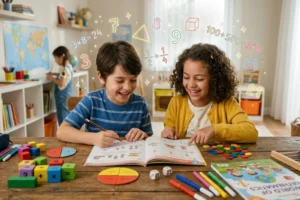
There are certain ages in a child’s life when everything starts to look a little different. 8 and 9 years old is exactly such a period. At this age, which corresponds to the third and fourth grades of primary school, children begin to make sense not only of what they see, but also of what they think. They constantly ask questions, make connections, and wonder why things happen. Math is at the very center of this change.
While for us adults math sometimes seems like just rules, calculations, and exams, for an 8- or 9-year-old child, the situation is quite different. They often see math as a game, a field of discovery, or a mysterious puzzle to be solved.
“As Long as I Can Do It, It’s Great”
The most influential factor in children’s feelings towards math at this age is the feeling of accomplishment. Being able to solve a problem on their own, noticing the relationship in the multiplication table, or correctly performing a seemingly difficult calculation is a great source of happiness for a child.
Children who understand the logic of the calculations, in particular, begin to enjoy math. Because for them, mathematics is no longer just numbers, but a game that encourages thinking. However, the opposite can happen in children who constantly think they make mistakes or feel inadequate. In such cases, mathematics can turn from a fun discovery into a stressful subject.
Therefore, children aged 8 and 9 often view mathematics based on this:
“I like it if I can do it.”
Numbers Are No Longer Just Objects
At younger ages, children usually learn mathematics with concrete things. Three apples, five pencils, or two toys… But when they reach 8 and 9 years old, things change a little. Fractions, large numbers, division, and geometric concepts come into play.
Now children need to understand not only what they see, but also what they visualize in their minds. This period is quite exciting for some children. Because they feel grown up. Working with large numbers or solving a difficult problem gives them the feeling of having deciphered a secret code.
But sometimes, if abstract concepts are not explained clearly enough, children may distance themselves from mathematics. Topics that aren’t supported by games, visuals, or everyday examples can become confusing for children.
Comparison with Friends Begins
Ages 8 and 9 are a time when children place more importance on their friends’ opinions. Situations like who does calculations faster in class, who solves problems first, or who the teacher praises more directly affect children.
Children who feel successful approach mathematics more positively, while those who feel they are falling behind may eventually think, “I can’t do math.” However, what children need at this age is not competition, but support while learning and the understanding that making mistakes is normal.
Because mathematics is closely related not only to intelligence but also to self-confidence.
“Where Will I Use It in Real Life?”
Children at this age begin to question why the information they learn is necessary. Simply writing calculations in notebooks often seems boring to them. But their interest can suddenly change when they see that mathematics is useful in real life.
The measurements used when preparing a recipe, counting money at the market, reading the clock, the scoring system in games, or completing a jigsaw puzzle… As children realize that mathematics is actually everywhere in life, they begin to look at the subject differently.
For them, mathematics is sometimes a way to win a game, and sometimes a sign of “feeling grown up.”
In Conclusion
For 8 and 9-year-old children, mathematics is not a subject defined by rigid lines. In their eyes, mathematics is a world that is sometimes fun, sometimes challenging, but always waiting to be explored.
At this age, children’s relationship with mathematics largely depends on their experiences. When they are supported, when they are not afraid to make mistakes, and when they can discover the logic of mathematics, they develop a positive view of the subject.
Perhaps what is important is to keep children’s curiosity alive before trying to make them love mathematics. Because a curious child will always find a way to learn.