Why Do Children Between 8 and 12 Start Thinking Differently in Math?
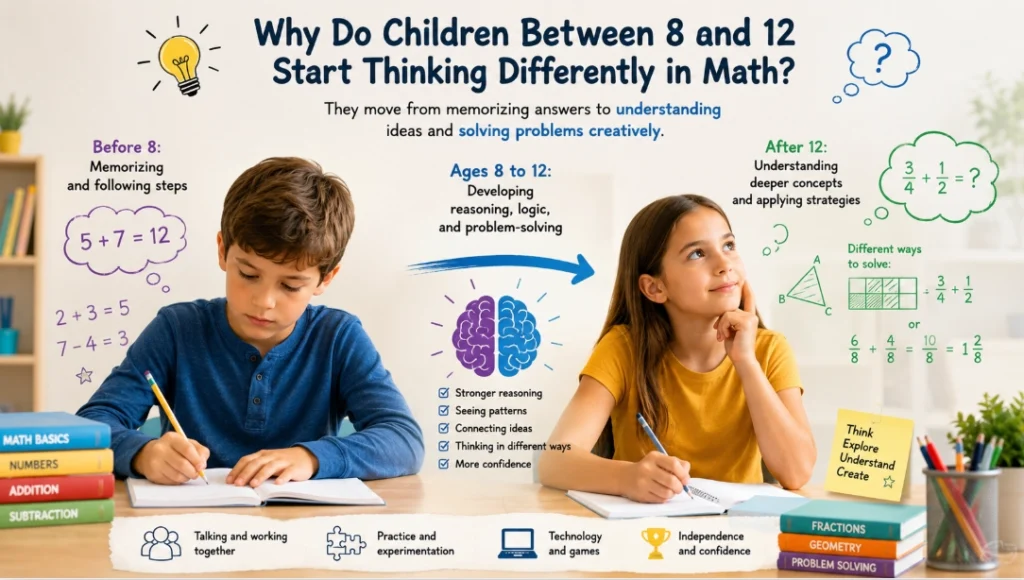
Children between the ages of 8 and 12 go through an important stage in their mathematical development. During these years, they begin to move beyond simple counting and memorization and start using reasoning, logic, and problem-solving skills in deeper ways. Mathematics becomes more than just numbers on a page; it becomes a way of thinking.
At younger ages, many children solve math problems by following steps they have memorized. For example, they may know that 5 + 7 equals 12 because they practiced it many times. However, between the ages of 8 and 12, children begin asking questions such as “Why does this work?” or “Is there another way to solve it?” This shift shows that their brains are developing the ability to think more abstractly.
One reason for this change is brain development. During these years, children’s memory, attention, and reasoning skills improve rapidly. They become better at recognizing patterns and understanding relationships between numbers. Instead of seeing numbers as isolated facts, they start connecting ideas together. For example, a child may realize that multiplication is repeated addition or that fractions and division are closely related.
School experiences also play a major role. Around this age, math lessons become more challenging. Students are introduced to fractions, decimals, geometry, and multi-step word problems. These topics encourage children to think carefully and apply different strategies. They learn that there can sometimes be more than one correct way to solve a problem.
Another important factor is confidence. Children who feel encouraged in math are more willing to explore and make mistakes. They begin experimenting with different methods and explaining their thinking aloud. This helps them develop mathematical reasoning skills, which are essential for future learning.
Social interaction can also influence mathematical thinking. When children discuss problems with classmates or teachers, they hear different ideas and approaches. This exchange of thinking helps them understand concepts more deeply. Working together on math activities often improves both communication and problem-solving abilities.
Technology and games can contribute as well. Educational apps, puzzles, and interactive activities make math more engaging for children. These tools often encourage logical thinking and creativity rather than simple memorization. As a result, children begin to view math as something active and enjoyable.
Between the ages of 8 and 12, children also become more independent learners. They start checking their own work, finding mistakes, and choosing strategies that make sense to them. This independence is an important step toward higher-level mathematical thinking.
In conclusion, children between 8 and 12 start thinking differently in math because their brains, experiences, and confidence are developing together. They move from memorizing answers to understanding ideas and solving problems creatively. This stage is extremely important because it builds the foundation for future success not only in mathematics but also in logical thinking and everyday decision-making.