What Does Mathematics Mean to 12-Year-Old Students?
The age of 12 is a unique stage in a child’s life. Students at this age are no longer seen as “little kids,” but they are also still discovering who they are and how they learn best. Their thoughts become deeper, their emotions stronger, and their curiosity about the world grows every day. Mathematics becomes an important part of this journey.
For 12-year-old students, math is no longer only about simple calculations or memorizing multiplication tables. It begins to represent challenge, logic, independence, and sometimes even identity. Some students start to love mathematics because it makes them feel capable and intelligent, while others may begin to struggle with confidence as topics become more difficult.
At this age, mathematics carries emotional meaning as much as academic meaning.
Mathematics Becomes More Complex
By the age of 12, students are introduced to more advanced mathematical concepts such as algebra, ratios, percentages, geometry, and problem-solving strategies. Unlike earlier years, they are expected not only to calculate answers but also to explain their thinking.
This shift changes how students view mathematics. Many children begin to realize that math is not simply about numbers on a page — it is about reasoning, patterns, and understanding relationships between ideas.
For some students, this feels exciting. Solving a difficult equation or understanding a new concept can feel like unlocking a secret code. It gives them a sense of achievement and independence.
For others, however, the increasing difficulty can feel overwhelming. When children do not fully understand the logic behind a topic, math may start to seem confusing or stressful. This is why patience, encouragement, and clear explanations become especially important at this age.
Students Want Meaning, Not Just Answers
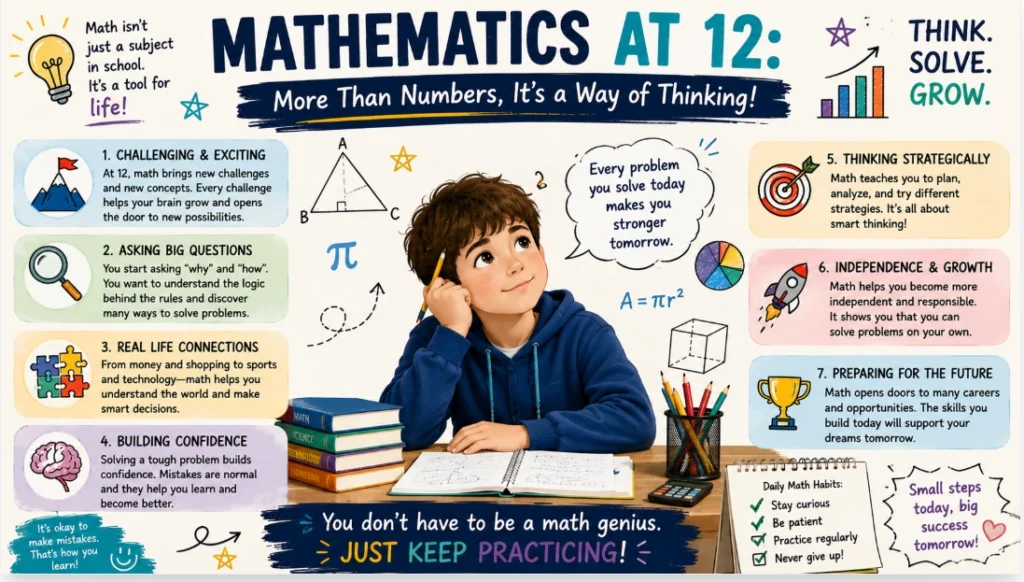
Twelve-year-olds are naturally more analytical. They often question the purpose of what they are learning. Instead of simply asking “What is the answer?” they begin asking:
“Why does this method work?”
“Where can I use this in real life?”
“Is there another way to solve it?”
At this stage, students usually dislike memorization without understanding. They want mathematics to make sense.
When teachers or parents connect mathematical ideas to everyday life — such as budgeting money, sports statistics, technology, architecture, or video game design — students become more engaged. They start to see mathematics as a useful tool rather than just another school subject.
Confidence Plays a Huge Role
At the age of 12, self-confidence becomes deeply connected to school performance. Students compare themselves to classmates more often, especially in subjects like mathematics where answers can appear “right” or “wrong.”
A positive experience in math can make students feel proud, motivated, and capable. They may enjoy participating in class, solving challenges, and helping others.
On the other hand, repeated struggles or fear of making mistakes can cause students to lose confidence quickly. Some children begin to label themselves as either “good at math” or “bad at math,” even though learning ability develops over time with practice and support.
This is why emotional encouragement matters so much during middle school years. Students need to understand that mistakes are part of learning, not proof of failure.
Mathematics and Real Life Connections
One of the biggest changes at this age is that students begin noticing mathematics everywhere around them.
They see it in technology, social media algorithms, sports scores, shopping discounts, coding, science experiments, and even music patterns. Mathematics starts to feel connected to the real world in a much more meaningful way.
For many 12-year-olds, understanding this connection changes their attitude completely. Instead of seeing math as pages full of exercises, they begin to understand that mathematics helps people solve real problems and make smart decisions.
This realization often increases both curiosity and motivation.
The Desire for Independence
Twelve-year-old students also begin developing stronger independence. They want to solve problems on their own and prove that they can think critically without always relying on adults.
Mathematics gives them opportunities to do exactly that. Every successfully solved problem becomes a small reminder that they are growing intellectually and becoming more responsible learners.
In this way, math becomes more than a school subject. It becomes part of how students build resilience, patience, and confidence in themselves.
Conclusion
For 12-year-old students, mathematics represents much more than calculations and formulas. It is a subject that challenges their thinking, strengthens problem-solving skills, and helps them better understand the world around them.
Their relationship with mathematics during this stage often shapes how they view learning in general. Whe