Examining the Learning Environment in the Context of Mathematical Competence
Examining the Learning Environment in the Context of Mathematical Competence
Mathematics education spans a broad timeframe, starting from the preschool period and extending through primary education and beyond. The purpose of mathematics teaching is to equip individuals with problem-solving skills alongside the knowledge and skills required for daily life, and to foster a mindset that approaches situations through a problem-solving perspective. For the provided mathematics education to achieve its purpose, it primarily depends on developing educational curricula that meet the demands of the modern era.
Education, regarded as the most crucial component of economic and social development, is undergoing rapid and continuous change worldwide; it has become one of the most effective tools for political, social, and cultural integration, as well as for managing change. The most critical condition for education to fulfill its current functions is the renewal of educational curricula in accordance with emerging needs.
Mathematical competence should not be understood merely as succeeding in a math class. Being mathematically competent means having the mathematics-related proficiencies an individual might need in all areas of life and being able to use them masterfully.
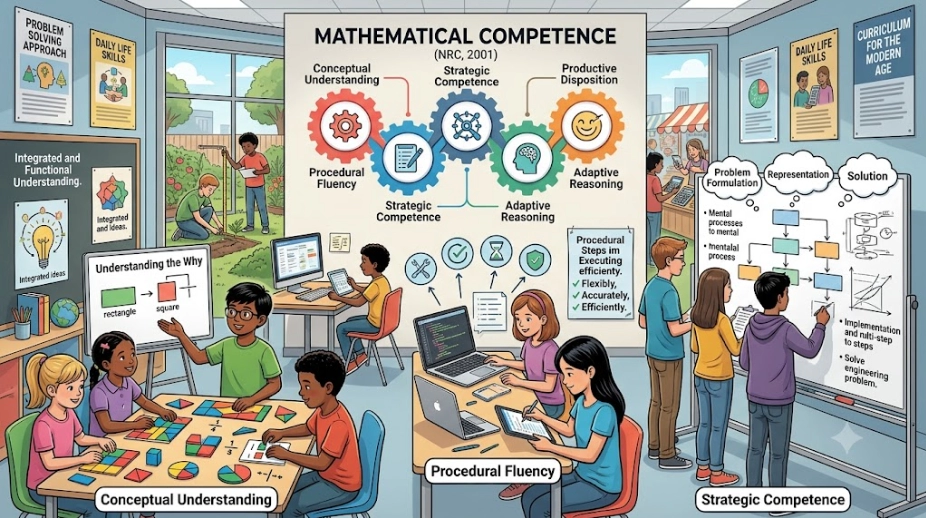
This mastery involves possessing the necessary knowledge and being able to use it sufficiently, as well as having a willing disposition toward activities that involve mathematics. In other words, mathematical competence can be considered a combination of knowledge, skills, and attitudes. Several theoretical classifications have been made in the literature regarding these components of mathematical competence (Niss and Jensen, 2002; OECD, 2019; National Research Council [NRC], 2001). Among these classifications, a study conducted by the NRC (2001) in the United States investigated how primary school-age students learn mathematics and stated that mathematical competence consists of five intertwined components (conceptual understanding, procedural fluency, strategic competence, adaptive reasoning, and productive disposition).
According to the NRC (2001), conceptual understanding is the comprehension of mathematical concepts, operations, and relations; in other words, it is the integrated and functional understanding of the fundamental ideas of mathematics. Procedural fluency is the skill to carry out mathematical procedures flexibly, accurately, efficiently, and appropriately. Strategic competence, defined as the ability to formulate, represent, and solve mathematical problems, requires the effective execution of mental processes and implementation steps in problem-solving.