
Integer Subtraction Problems: Common Mistakes and How to Fix Them
 By
By Integer subtraction problems trip up more middle school students than almost any other math topic, mainly because subtracting a negative number feels backwards at first. This guide breaks down the most common errors, shows you exactly what goes wrong, and gives you clear fixes so you can tackle these problems with confidence.
- Why Integer Subtraction Problems Feel Hard
- The Most Common Mistakes Students Make
- The Keep-Change-Flip Rule Explained
- Negative vs. Positive Results: How to Tell the Difference
- Sign Rules Side by Side: A Quick Comparison
- Step-by-Step Fix Checklist
- Practice Tips That Actually Work
- Frequently Asked Questions
Why Integer Subtraction Problems Feel Hard
Integer subtraction feels confusing because subtracting a negative number actually increases the value, which goes against everyday intuition. In standard arithmetic, subtraction always makes a number smaller. With integers, that rule no longer holds: 5 – (-3) = 8, which is larger than 5. This single fact is responsible for a huge share of errors students make in grades 6 and 7.
The confusion is not a sign of low ability. Research in math education consistently shows that the transition from whole-number thinking to integer thinking is one of the steepest conceptual jumps in middle school mathematics. Recognising that the jump is normal is the first step to getting past it.
“Subtracting a negative number is the same as adding its positive counterpart. Once that clicks, integer subtraction stops feeling like a trick and starts feeling like a rule.”
The Most Common Mistakes Students Make
Most errors in integer subtraction fall into a small set of predictable patterns, which means they are also predictable to fix. The table below maps each mistake to its cause and the correct approach.
| Mistake | Example (Wrong) | Example (Correct) | Root Cause |
|---|---|---|---|
| Dropping the second negative sign | 5 – (-3) = 2 | 5 – (-3) = 8 | Treating “- -” as a single minus |
| Subtracting absolute values without checking signs | -7 – 4 = 3 | -7 – 4 = -11 | Ignoring the direction of both numbers |
| Flipping the sign on the wrong number | 3 – (-5) = -2 | 3 – (-5) = 8 | Applying Keep-Change-Flip incorrectly |
| Confusing subtraction with multiplication sign rules | -4 – (-4) = 16 | -4 – (-4) = 0 | Mixing up operation rules |
Spotting which pattern applies to your own errors is the fastest path to improvement. Keep a short list of recent wrong answers and match them to the table above.
The Keep-Change-Flip Rule Explained
Keep-Change-Flip (also called KCF) is the most reliable shortcut for converting any subtraction problem into an addition problem. It works every time with integers: keep the first number, change the subtraction sign to addition, and flip the sign of the second number.
| Original Problem | After Keep | After Change | After Flip | Answer |
|---|---|---|---|---|
| 6 – (-2) | 6 | 6 + | 6 + 2 | 8 |
| -3 – 5 | -3 | -3 + | -3 + (-5) | -8 |
| -8 – (-1) | -8 | -8 + | -8 + 1 | -7 |
Once the problem is rewritten as addition, standard integer addition rules take over and most students find it much easier. KCF does not change the answer; it only changes how the problem looks on paper.
“Keep-Change-Flip converts every integer subtraction problem into an addition problem. That one transformation removes the most common source of errors.”
Negative vs. Positive Results: How to Tell the Difference
The sign of the final answer depends on which number has the greater absolute value, not simply on which operation you performed. Absolute value means the distance from zero, ignoring the sign: the absolute value of -9 is 9, and the absolute value of 4 is 4.
A simple decision rule: after applying KCF and converting to addition, compare the absolute values of the two numbers. The answer takes the sign of whichever number has the larger absolute value. For example, -9 + 4: the absolute value of -9 (which is 9) is greater than 4, so the answer is negative: -5.
Sign Rules Side by Side: A Quick Comparison
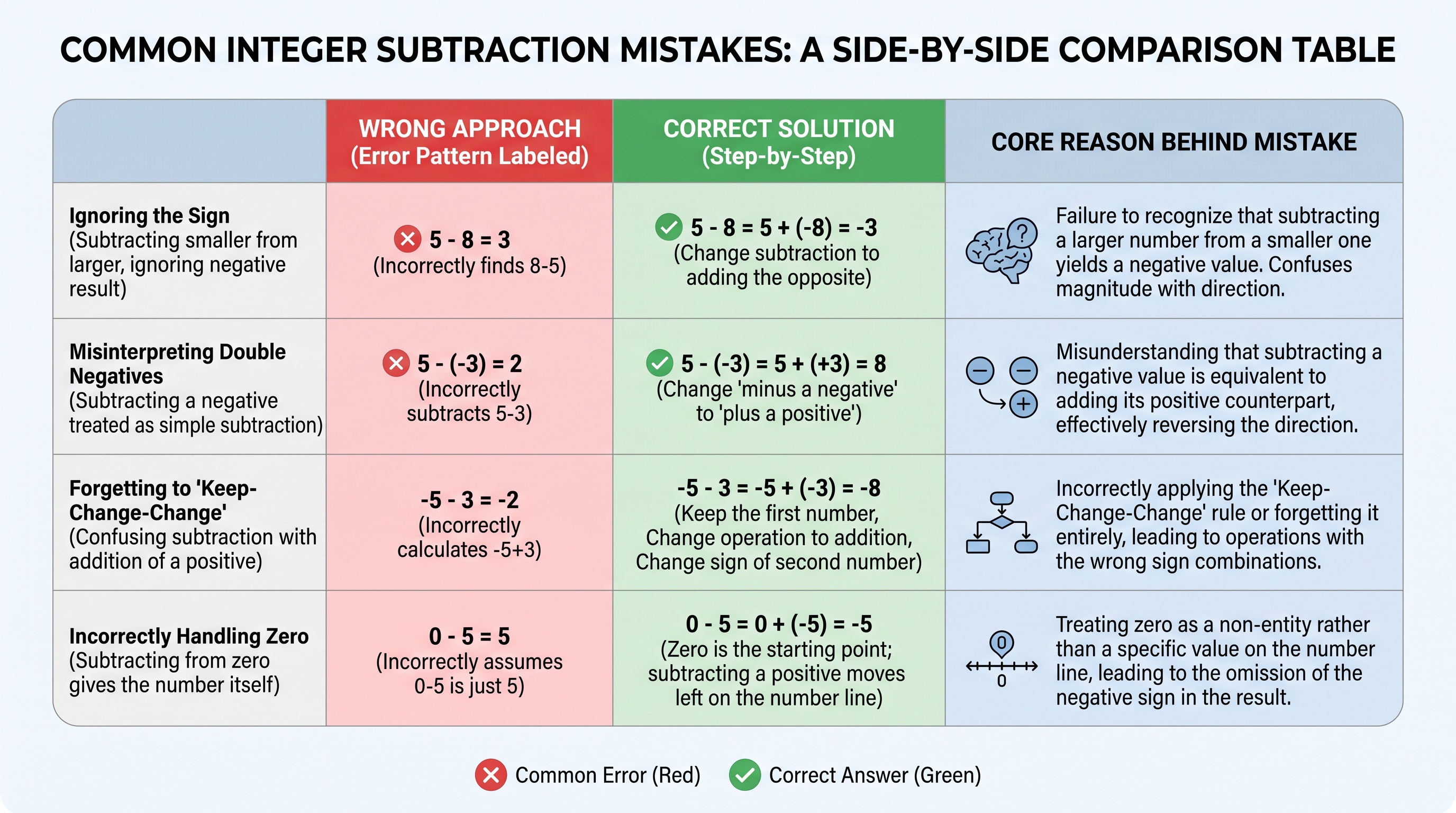
Students often mix up sign rules across different operations. This table shows how subtraction sign rules compare to addition and multiplication sign rules so you can keep them straight.
| Operation | Positive + Positive | Negative – Negative | Positive – Negative |
|---|---|---|---|
| Result tendency | Always positive | Depends on size | Always larger (more positive) |
| Example | 4 + 3 = 7 | -6 – (-2) = -4 | 4 – (-3) = 7 |
| Key rule | Add normally | Use KCF, then compare absolute values | Use KCF: becomes addition |
Keeping these three columns in mind prevents the most common cross-operation confusion. Never apply multiplication sign rules (“two negatives make a positive”) to addition or subtraction problems. That is a different rule for a different operation.
Step-by-Step Fix Checklist
Use this checklist every time you attempt an integer subtraction problem until the steps feel automatic. Going through it slowly on a few problems is faster in the long run than rushing and repeating the same mistakes.
- Identify both numbers and their signs before doing anything else. Write them clearly.
- Apply Keep-Change-Flip to convert the subtraction to addition.
- Compare absolute values of the two numbers to predict the sign of your answer.
- Add the absolute values as if they were whole numbers.
- Attach the correct sign to your result using the comparison from step 3.
- Double-check by asking: does this answer make sense on a number line?
A number line is one of the most reliable checking tools available. Moving left means subtracting a positive number; moving right means subtracting a negative number (or adding a positive one).
Practice Tips That Actually Work
Consistent, varied practice is more effective than drilling the same problem type for a long time. Students in grades 6-7 benefit most from mixing problem formats: written equations, word problems, and number-line exercises all reinforce different aspects of integer thinking.
For interactive practice at home, explore the math games and activities for 11-year-olds on Maths Fun Hub, where integer subtraction problems appear in game formats that make repetition feel less like homework. Games with immediate feedback help students catch sign errors in real time rather than discovering them days later on a graded paper.
Three habits that produce measurable improvement:
- Write out KCF steps on paper, even for problems that feel obvious, until the rule is fully automatic.
- After getting a wrong answer, identify which step of the checklist above broke down, not just what the correct answer was.
- Practice in short daily sessions (10-15 minutes) rather than long, infrequent sessions. Spaced repetition strengthens memory more efficiently.
“Identifying the exact step where an error occurred teaches more than simply seeing the correct answer. That habit turns mistakes into learning moments.”
Frequently Asked Questions
Why does subtracting a negative number give a larger result?
Subtracting a negative number is mathematically the same as adding a positive number. The two negatives cancel each other out, so the result moves to the right on the number line, which means a larger value. For example, 5 – (-3) = 5 + 3 = 8.
What is the Keep-Change-Flip method and when should I use it?
Keep-Change-Flip is a three-step shortcut for integer subtraction: keep the first number unchanged, change the subtraction sign to addition, and flip the sign of the second number. Use it every time you see a subtraction sign in an integer problem until the idea becomes automatic.
How can I tell if my answer to an integer subtraction problem will be positive or negative?
After converting the problem to addition using KCF, compare the absolute values of the two numbers. Your answer takes the sign of whichever number has the larger absolute value. If both numbers share the same sign after conversion, add them and keep that sign.
At what grade level do students typically learn integer subtraction?
Integer subtraction is a core topic in grade 6 and grade 7 mathematics in most curricula, including the Common Core State Standards used widely in the United States, where it appears under the Number System domain. Some students encounter it as early as grade 5 in enrichment contexts.